The full-size coach (pullman gran turismo)
For a group of about 35 or more, the pullman gran turismo is the standard choice: typically 49 to 57 seats, with luggage holds under the floor. It is hired with a driver from a licensed partner operator under Legge 218/2003.
Who may run it
The operator holds an authorisation from the region where it is based, valid anywhere in Italy, and a certified copy travels on every coach registered under it. The driver holds a category D licence and the CQC card. A tachograph records driving and rest, and the alcohol limit for the driver is zero. These are the operator's duties; the organiser's part is a clear programme with times and addresses.
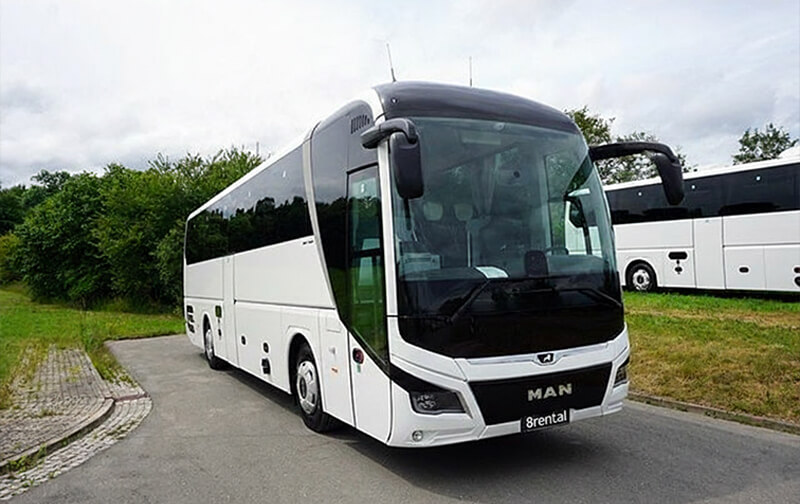
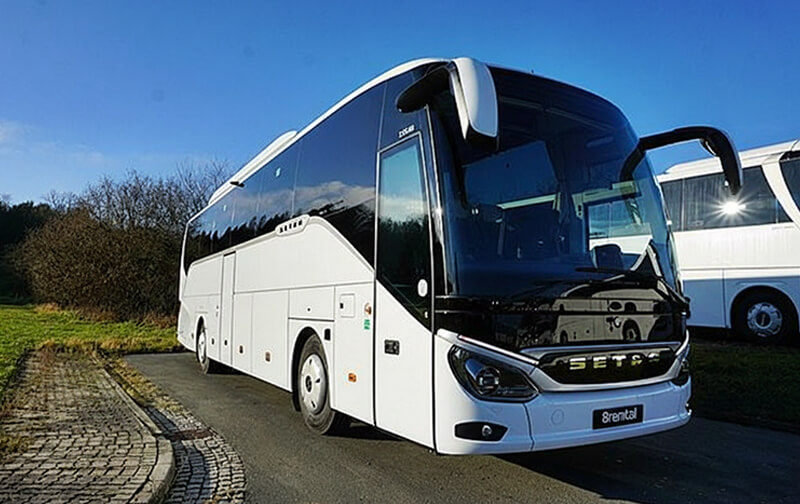
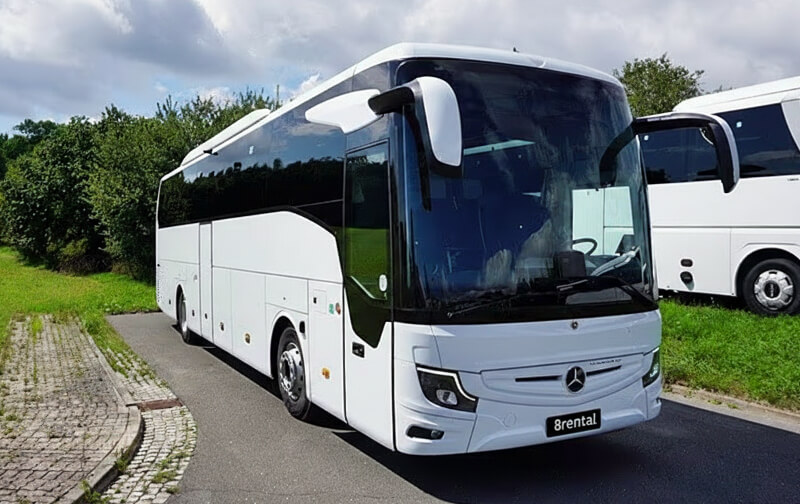
Seats and luggage
- Seats: 49-57
- Luggage: Underfloor luggage holds
Rules and equipment on board
- Hiring a bus with a driver in Italy (noleggio di autobus con conducente) is governed by Legge 218/2003: a professional company carries a group for one or more trips requested by a client, or offered to a pre-formed group, with the period, the duration and the total amount for the bus agreed in advance (art. 2 c. 2)
- The company needs an authorisation from the region (or the delegated local authority) where it has its registered office; the authorisation has no territorial limits, and international work also needs international professional competence (L. 218/2003 art. 5 c. 1 and 3)
- A certified copy of the authorisation is kept on board every bus registered under it (L. 218/2003 art. 5 c. 5)
- Under the Codice della Strada, a bus (autobus) is a vehicle for carrying people with more than nine seats including the driver (art. 54 c. 1 b)
- The driver holds a category D licence, for vehicles built to carry more than eight people besides the driver, and the driver qualification card for passenger transport (carta di qualificazione del conducente, CQC) (art. 116 c. 3 p and c. 11)
- Buses and trolleybuses with a gross weight over 8 t are limited to 100 km/h on motorways and 80 km/h on other roads outside built-up areas (art. 142 c. 3 f)
- A tachograph is required as set by EU law, and speed limiters where EU directives require them (art. 179 c. 1)
- Drivers of buses and of vehicles carrying people professionally must not drink any alcohol before driving: the limit is zero (art. 186-bis c. 1)
Speed and timing
100 km/h on motorways and 80 km/h on other roads outside towns are the maximums for a bus over 8 t, not cruising speeds. Lower signed limits come first, and traffic does the rest. Plan with coach times: Rome to Florence is about 3 h 45 min, Milan to Verona about 2 h 20 min, Venice to Bologna about 2 h 15 min.
With a 9-hour daily driving cap, a long transfer plus sightseeing at both ends may need a second driver. Ask for it on the quote.
Where it does not go
Size rules out some famous roads. On the Amalfi Coast, the SS163 is closed to buses beyond 10.36 m in length or 4 m in height. Above 10.5 m, the Lariana lakeside road to Bellagio is off limits too. The Cinque Terre villages are reached by train or boat from La Spezia, not by coach.
In city centres the obstacle is often emissions. Rome bars Euro 4 and older coaches from its coach zones, and Milan's Area C admits only Euro VI buses, so the operator checks the vehicle's eligibility before confirming.
Questions organisers ask
When does a midi-coach make more sense?
Below about 35 passengers, on hill roads, at small venues, and on the Amalfi Coast, where a full-size coach is not allowed.
What luggage fits?
The underfloor holds take the main luggage. Mention skis, instruments, bikes or folded wheelchairs on the request so the operator can check the space.
Do passengers have to wear belts?
Yes, everyone over three, using the belt fitted to the seat. A sign or pictogram at each seat reminds them.
Other group trips we arrange
- Coaches for conferences, incentives and staff days
- School trips by coach, planned around the permits
- Coaches for teams, clubs and supporters
- Moving wedding guests by coach
- Winery days by coach, with a driver who never tastes
- Day trips by coach from Italian cities
- Coach transfers to and from Italian cruise ports
- Accessible group transport in Italy